ISRAEL PHOTOS V -- Spring 2011 |
MAGDALA
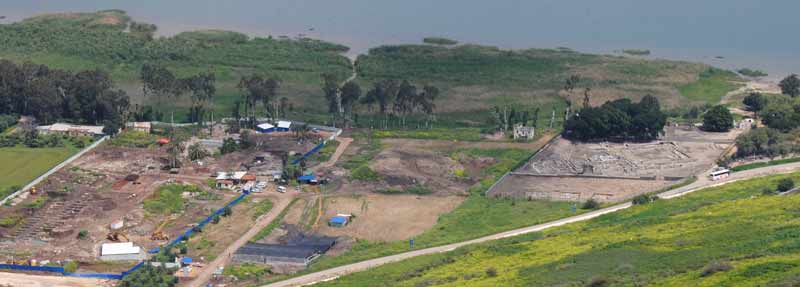
APRIL 8, 2011 SHOWING THE EXCAVATIONS AT MAGDALA
Early travelers reaching the shores of Lake Tiberias found a small village in the NW corner of the lake named Medjal or Medgdel. George Smith identified this place as Magdala in 1896. Medjal is like the Aramaic word Migdal meaning tower. A Jewish settlement named Migdal was founded on a hill above the ruins in 1910. It is still there.
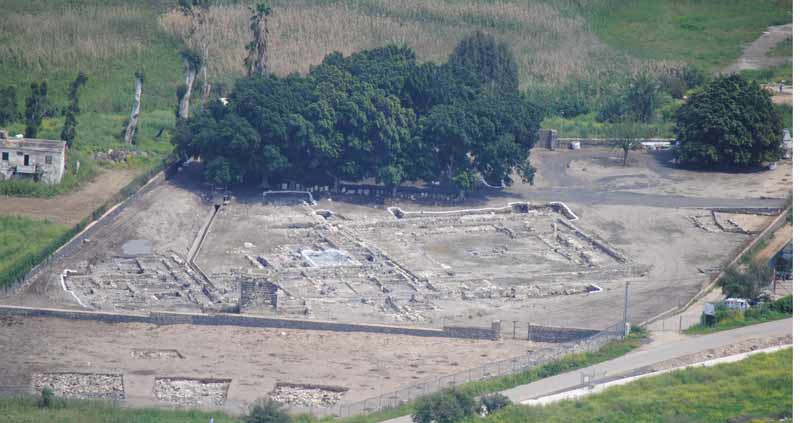
In the Gospel of Matthew, chapter 15, Jesus fed 4,000 and then they went to Magadan. According to Barnabas Meistermann (1907) the word Magdala occurs in place of Magadan in numerous Greek and Syriac Gospel manuscripts. The Jewish Midrash stated the place was known as Migdal Nounya - fish tower or fish quarter and Migdal Ceboya - dyers tower or dyer's quarter. Ruins of a tower are visible in the second photo from the top. There were 80 shops for dying wool and 300 shops selling pigeons for temple sacrifices. Wadi Hamam meaning "valley of pigeons," is near the ruins of Magdala. Thousands of pigeons roosted on the cliffs above Magdala.
Mary Magdalene (from Magdala), was a friend of Jesus (Luke 8:1-3), witnessed his crucifiction (Matthew 27:61) and resurrection (Mark 16:1-8).
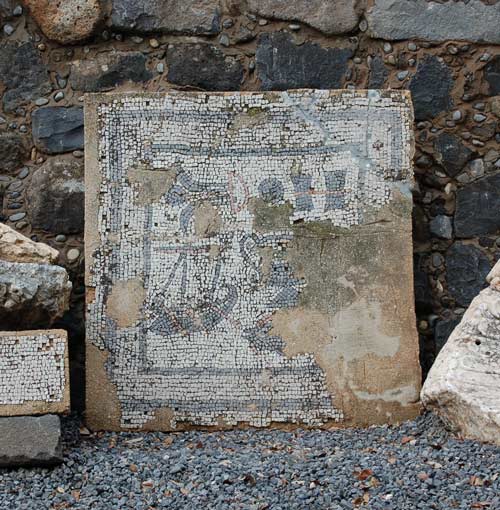
While the excavations seen in the lower photo were taking place, a Roman era floor mosaic with a picture of a six oared sail boat was found and placed on display at Capernaum. While doing a salvage excavation at the planned site of a Catholic conference center at Magdala, the Israel Antiquities Authority discovered the remains of a first century synagogue in 2009. Three first century ritual immersion pools (mikvaot) were also discovered by archaeologists.
An early description of Magdala by Cunningham Geikie (1887, London):
Magdala stands on the south corner of the Plain of Gennesaret. Two or three fig-trees grow in or near the houses, and there are a few wretched gardens, with palms in them a few feet high. A small brook sends a trickle of water to the lake over a stony bottom, but it is not irreproachably pure, for it has to run through dunghills. The houses, or huts, of which there are not more than dozen altogether, are built of mud and stone, and are of one storey and flat-roofed, with no light except from the door; a rough pillar of mud and stone in the one room holds up the ceiling of reeds and branches, and two levels in the mud floor mark the respective bounds of man and beast; for fowls, goats, and perhaps an ass, or some other creature, share the premises with the family. Some unspeakably dirty, almost naked, children followed us about. The ground was rank with brambles, wild mustard, coarse grass--which, if drawn smartly through one's fingers, would cut them--and low prickly bushes, with the beds of black basalt fragments of all sizes. An old keep, originally built, it is said, as a "fish tower," rose beside a ruinous pool, once full of fish, but now mostly filled with stones, and leaking so that the soil for some distance round was quaggy with water. Five or six springs, breaking out of the earth some distance up the valley, feed this old reservoir, and then make their way through the stones to the lake. Eight fig-trees and some elder-bushes, fed by the moisture, helped to hide the misery of the spot; and there were here and there a few oleanders, Christ-thorn trees, and other semi-tropical growths. Such is the village of Mary whom we now call the Magdalene...
Geikie went on to describe the nearby Wadi Hamam (Valley of Pigeons), Irbid, and the cliffs now called the Cliffs of Arbel.
Photos of the Synagogue at Magdala
Biblical Israel Tours Magdala Synagogue Photo
BIRDS
PERCHED ON MUSTARD BRANCHES
MARONITE
CHURCH CLIFF
RECENT EXCAVATIONS AT THE POOL OF SILOAM
RECENT EXCAVATIONS AT MAGDALA