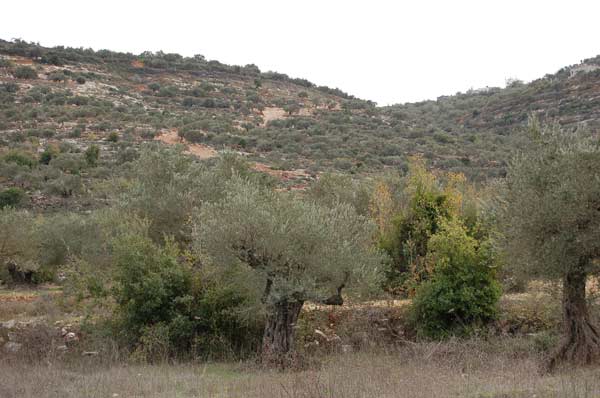
Israel -- Olive Grove (January 2006)
ISRAEL PHOTOS III -- A COLLECTION OF PHOTOS FROM ISRAELWITH DESCRIPTIONS OF SCENES AND SITES PERTINENT TO THE STUDY OF CHRISTIANITY |
Jesus At A Well Near Shechem
In the Gospel of John, Jesus was going from Judea in the south toward Galilee in the north. He was passing through Samaria at Sychar (Shechem). Jesus met a woman by Jacob's well and talked to her while his disciples went into town to buy food. While conversing, Jesus told the woman she had five husbands and the one she was currently going with was not her husband. The woman had never met Jesus before and concluded he was prophesying.
John 4:28 (WEB) So the woman left her water pot, went away into the city, and said to the people, 29 Come, see a man who told me everything that I did. Can this be the Christ?
30 They went out of the city, and were coming to him. 31 In the meanwhile, the disciples urged him, saying, Rabbi, eat.
32 But he said to them, I have food to eat that you don't know about.
33 The disciples therefore said to one another, Has anyone brought him something to eat?
34 Jesus said to them, My food is to do the will of him who sent me and to accomplish his work.
35 Don't you say, There are yet four months until the harvest?
Behold, I tell you, lift up your eyes and look at the fields, that they are white for harvest already.
36 He who reaps receives wages and gathers fruit to eternal life; that both he who sows and he who reaps may rejoice together. 37 For in this the saying is true, One sows, and another reaps.
38 I sent you to reap that for which you haven't labored. Others have labored, and you have entered into their labor.
39 From that city many of the Samaritans believed in him because of the word of the woman, who testified, He told me everything that I did.
Jesus was speaking to the residents of Shechem who had a saying; four months and then the harvest.
He said the fields were already white for harvest. Barley or wheat starts out green then turns tan white as it ripens. It must then dry awhile before it is harvested. The barley was ready for harvest four months after it was planted.
At one time I presumed Jesus was going from Jerusalem to Galilee after the Passover and it was probably at least April by the time he got there. Four months later the olive harvest might begin. They picked the green olives first to make virgin olive oil as early as September and picked the darker salad olives in October or November. There are many olive trees in Samaria as the region is hilly and mountainous.
Jesus had his disciples with him, so his visiting the woman in Samaria happened after he called his disciples. The Gospels are not always in chronological order, but sometimes the events and speeches were written outside of chronological order. The account of Jesus driving the merchants out of the temple was near the beginning of the Gospel of John, but near the end of the other Gospels. I think there was only one time Jesus drove the sellers of sacrificial animals and money changers out of the temple. That was during his last days in Jerusalem
Jesus emphasized there was work to be done that day. God has all sorts of work available. Jesus was teaching people the word of God. Fields are ready for the harvest today. I have not figured out the exact time Jesus was visting the Samaritan woman at Jacob's well in Samaria.
Parable of the Mustard Seed
A Mustard Field Along Highway 87-North Shore of Galilee
Mustard Seeds in the Palm of a Hand
Mustard Flowers
Giant Mustard
Upper Most Seats of the Synagogue
The Fig Tree
Mt of Olives Fig Tree, April 12-13, 2005
Fig and Pomegranite Trees Below Siloam in Jerusalem
Sycomore Fig Tree
The Good Shepherd
The Parable of the Sheep and the Goats
Goat Herder
Camels
Ritual Cleansing
Shechem
The Olive Harvest of Samaria
Mt. Ebal
Olive Tree
Pearl of Great Price
A First Century Synagogue at Gamala
Overview of Gamala
Modern Galilee Fishing Boats
Kursi
Caves and/or Tombs
Steep Slope Near Kursi
Hippos
Feeding the 5,000
On the Mountain
Walking on Water
Ramot-Tzelon area
Mt. Hermon
The Pools of Bethesda in Jerusalem
Healing Pools
Crusader Chapel and St. Ann Church
Pool of Siloam in Jerusalem
Hezekiah's Tunnel
Overlook to Siloam
Tower of Siloam
A Watch Tower in a Vineyard/Olive Grove
Grape Vines at Beth Horan
Towers
Mt. Precipice
South Face
Summit
Over the edge
Measuring Line
View of Nazareth from near Megiddo
Nazareth
The Basilica of the Annunciation
Capernaum
Healing a Paralytic in Capernaum
Bethsaida
Waterskins and Wineskins
The Fish and the Coin
Barbel
A Denarius
Casting Out a Demon
The Road to Jericho
Old Roman Road
Wilderness Above Jericho
Old Jericho
Western Wall
Gethsemane and the Cave of Gethsemane
Church of the Holy Sepulcher
Rolling Stone Tombs - Jerusalem
Other Rolling Stone Tombs
Tiberias
Solar Power in Israel
Salt of the earth
Chorazin
OTHER WEB SITES BY DAVID HALL:
Israel Photos VI
Israel Photos V -- Spring 2011
Israel Photos IV -- Pilgrimage
DQHALL.COM