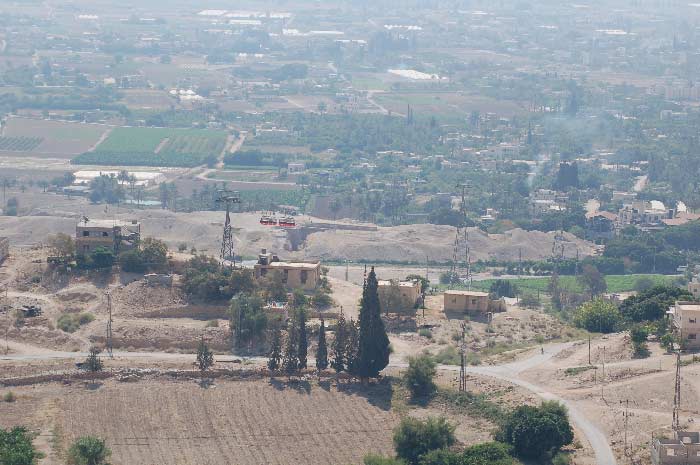
Kenyon's trench #1 left in old Jericho mound below cable cars in center of photo - July 2006
ISRAEL PHOTOS III -- A COLLECTION OF PHOTOS FROM ISRAELWITH DESCRIPTIONS OF SCENES AND SITES PERTINENT TO THE STUDY OF CHRISTIANITY |
Kenyon's trench #1 left in old Jericho mound below
cable cars in center of photo - July 2006
According to what is currently known about the archaeological record for Israel along the coast, in the Shephelah, in the hill country, and along the Jordan R. Valley, Joshua could not have destroyed or encountered a number of the cities credited to his military conquest in the book of Joshua as they were not occupied close to the end of the Bronze Age when some Biblical scholars expected Joshua had crossed the Jordan.
Kathleen Kenyon excavated Jericho in the 1950’s. Kathleen Kenyon found that the city was destroyed at the end of the Early Bronze Age about 2200-2100 B.C. the walls were fallen down and the city was burned. It was rebuilt later about 1900 B.C. During the Hyksos (MBII) times it was fortified with a sloped hillside coated with plaster sloped at 35 degrees and 11 meters high. According to Kenyon sometime after or coinciding with the Hyksos expulsion from Egypt in 1575 B.C. (in 1992 Grimal published Ahmose was made king of Egypt in 1552 B.C. -- close to the time of the expulsion) the walled MBA city was destroyed. The upper most layer of town with fortification walls was burned. Pottery found in erosion gulleys on the mound and in nearby tombs was found to account for Jericho regional occupation until about 1325. A scarab of Thutmosis III and a scarab of Hatshepsut was found in a burial site. The area may have remained in use until about 1400-1325 as a scarab of Amenophis III and pottery was found in a tomb in the necropolis. Garstang used this collection as the benchmark for the last Late Bronze Age occupation of the mound, although the finds from this era were few in number and could not compare to the artifacts from the MBA when the city reached its zenith and encompassed about 12 acres of land. The Early Bronze Age city was about six acres in size. A single dipper juglet dated by Kenyon to 1350-1325 was found on the western acropolis on top of the floor of an "LBA house" different from the LBA building M described by Garstang on the slope of the mound facing the spring. The necropolis was mainly EB, MBA, with a little early LBA usage. The Iron Age artifacts were 10th century or later. Garstang wrote the walled MBA city was destroyed c. 1600; the time of the end of the Hyksos rule in Egypt. Kenyon wrote the walled MBA city was destroyed c. 1575. More recent dating by the Italian expedition pushed the date ahead to c. 1552 B.C. They attributed the devastation to attacks occurring as the Hyksos rule of Egypt and Canaan ended. Their dates did not agree due to differences in chronology theory over the years. There was widespread destruction of cities in southern Canaan coinciding with or sometime after the expulsion of the Hyksos from Egypt close to the end of the MBA. Kenyon's soundings of the erosion gullies did not produce LBA pottery after c. 1350-1325. Some LBA pottery washed down the slope and mixed with ruins of the MBA palace and houses near the spring gate of the city. Some Iron Age pottery was found on the slopes near Trench I. A few Late Bronze Age II dwellings may have been built against the remains of the MBA rampart above the floor of the moat that was filled in after the MBAII destruction of walled Jericho, yet there was no LBA walled city as Kenyon found Garstang's LBA walls were really EBA walls that had been subsequently dug into by those collecting organically rich soil for field enrichment or mud for new bricks. The borrow pits contained some LBA I pottery. Garstang claimed he had not found a single piece of LBA pottery on the site that was later than 1400 B.C. from the mound and in the tombs, his date must be moved down as the time for Amenophis III ended about 1350 BC and a scarab of Amenophis III was found a tomb along with Cypriot forms including the bilbil. There was no Mycenaean pottery found by Garstang. Mycenean pottery is a marker for the time period 1400-1200 BC in Canaan. Garstang reported seven pieces of LBA II pottery out of thousands of artifacts reported from the tombs, mainly from the EBA-MBA periods. The evidence from the tombs indicates the site may have been abandoned during the time of Amenophis III or Amenophis IV after a brief period of lesser occupation without a city wall building episode. As Garstang was eager to find the walls destroyed by Joshua towards the end of the Late Bronze Age he identified a section of mudbrick city wall as a Late Bronze Age wall. Kenyon traced the same wall to its foundations and found it to be an EBA wall totally covered with EB layers except where the EB wall totally collapsed and was covered with MBA remains. Due to rain storms and earthquakes mudbrick walls sometimes collapsed and had to be rebuilt. The times when the walls were rebuilt was also difficult to determine. The primary EB walls of interest enclosed a six acre portion of the city. The walls consisted of an inner twelve foot thick mudbrick wall and a later six foot thick mudbrick wall upon a low stone foundation joined in some places by perpendicular walls. Due to mud brick walls sometimes collapsing in rainstorms and the incidence of earthquakes there were numerous repairs and reconstructions of the EBA walls on the city mound. When a section of wall collapsed it was leveled and built up again. The Hapiru rebellion originating in Syria and spreading to Shechem and southern Israel was making trouble for people in Israel/Palestine about 1350 BC (Amarna era of Egypt). This may have been the reason the mound was abandoned again c. 1350 BC. The mound was twelve acres at its zenith in the Middle Bronze Age, it was six acres towards the center of the mound during the Early Bronze Age. There was no evidence of large scale mudbrick building projects in the LBA found by Garstang, this may account for the lack of LBA remains on top of the mound, although there were reports of Byzantine building remains on top of the mound. There was one stone Iron Age house found on the east side of the mound near the spring by Garstang. The other Iron Age houses were outside the remains of the MBA revetment, glacis, and rampart. The LBA building found on the east side of the tell near the spring was thought to be part of a small Egyptian garrison as evidenced by the scarabs in the tombs from the times of Thutmosis III, Hatshepsut., and Amenophis III. These were times when Egypt exploited Canaan as a colonial interest. The town was thought to be reinhabited by Jews after 800 B.C. By digging around the base of the mound the remains of the Iron Age II town were found outside the walls of the collapsed MBII town. Some Iron Age ruins and pottery was also found in the erosion wash on the western slope of the mound. Joshua did not likely take LBA Jericho as it was not a walled city at that time and was small in its dimensions. It was abandoned during a time when some historians claimed Joshua's campaign c. 1230 was supposed to have taken place. About 1350 B.C. a small settlement at Jericho was abandoned. Kenyon identified 14th century pottery, but no 13th century pottery. During the entire LBA it was not a great walled city with houses on top of the walls although there may have been reuse of the MBA glacis. Due to the fact most of Jericho was not inhabited in the LBA may explain the erosion that took place at that time.
Historians credited the destruction of fortifications in Southern Canaan from circa 1550 BC to the Egyptians. This was when the last city walls of Jericho were destroyed. The hill country of Israel was partially depopulated by Egyptian military campaigns as captive were taken back to Egypt during the early LBA. Canaan did not see major expansion the collapse of Egyptian colonial interests in Canaan during the early Iron Age.
In 1997 the Italian expedition opened up areas surveyed by Sellin, Garstang, and Kenyon. They found the strata in the order described by Kenyon and affirmed the outermost wall was a MBII-MBIII wall. They cleared the area at the south end of the mound, made footpaths, and preserved some of the mud brick walls for tourists to view. The area is currently open to the public and with signs describing the dates of the various walls. Garstang claimed to have found the LBA walled city of Jericho. Kenyon found the city of Jericho only lightly occupied in the LBA when it was theorized Joshua had attacked. The walls of Jericho had collapsed long before the late LBA
Archaeology in the Holy Land, Kenyon, 1960. Jericho, Holt, 1995, Amorites and Canaanites, Kenyon, 1963, 1966. Digging up Jericho, Kenyon, 1957. Recent Archaeological Discoveries, Dever, 1990. The Story of Jericho, Garstang, 1948. Palestine Exploration Quarterly 1950's editions (covering Kenyon's excavations), and the Palestine Exploration Fund Quarterly Statements 1930's editions (covering Garstang's excavations), A History of Ancient Egypt, Nicholas Grimal, 1992. Palestine Exploration Quarterly, 1998, #130, the Italian Expedition. Excavations at Jericho Volume IV, Kenyon and Holland, 1982. Quaderni di Gerico 2 (2000) English Edition/Italian excavations, Marchetti and Nigro, 2000. Jericho, Die Ergebnisse Der Ausgrabungen (summary of German excavations), Sellin and Watzinger, 1913.
Further up from the Jordan Valley towards Bethel north of Jerusalem there were the ruins of Ai (Et Tell) near Bethel. Bethel (Beiten) was 2 km. from Ai. In the book of Joshua both the men of Ai and Bethel had run out and attacked Israel (8:17), In the story Joshua defeated the people of Ai who along with the people of Bethel who had attacked him. Joshua was credited with burning Ai. J. Callaway dug at Et Tell (Ai) and found the third city was 27.5 acres in size and destroyed about 2400 B.C. and not rebuilt until the Iron Age I. Ai was one of the largest ruins in the region. The current evidence indicates that Jericho and the town of Ai were destroyed during different centuries, thus they could not have been destroyed by Joshua who was supposed to have lived forty years after leaving Egypt before attacking Canaan. Bethel (Beiten) was destroyed about the end of the LBA.
The Early Bronze Age Sanctuary at Ai (et-Tell), Joseph A. Callaway, 1972, Bernard Quartitch Ltd, LondonA more recent theory placed Ai about a kilometer away from Et Tell (Ai) at Khirbet el-Maqatir. Pottery from 1400 was reported there. This was about the time Egypt had numerous officials in Israel and Amenophis II was campaigning against rebellious cities in Canaan. Again the destruction of the walls of Jericho happened about 1550; a hundred and fifty years earlier
Hazor was occupied from the Middle Bronze Age until it was destroyed about 1250 B.C. (Ben Tor, BASOR #350 May 2008). More than 30 years ago Israeli archaeologist Yigael Yadin estimated Hazor was destroyed c. 1200 (Hazor, Yadin, 1975). Joshua was reported to have destroyed this city centuries after the MB age walled city of Jericho fell.
Heshbon in Jordan was supposed to have been destroyed by Israel in Numbers 21:25. The earliest remains from Heshbon were some remains from the Iron Age I (1200-1000 B.C.) published in an expedition report published by S. Horn. In the Song of Solomn (7:4) there was reference to the "pools of Heshbon." At Tell Hesban there were pools uncovered (Hesban After 25 Years) by David Merling). Hesban/Heshbon could not be found in any other location.
Mereneptah mentioned a campaign where he destroyed Israelis (Isr-r) in the Mereneptah Stele. The Egyptians did not have a sound for the character "L" in their alphabet, so they used "R." The stele was from 1209-1208 B.C. Since the reign of Merneptah began about 1213 B.C. the battle against Israel must have been about 1213-1208. The Philistines established Ekron about 1185 B.C. In Joshua (13:3) it was mentioned that Joshua was not able to take Ekron, Gaza, Ashdod, Ashkelon, and Gath the cities of the Philistines reckoned as Canaanite, while in Joshua 13:3 it was written that Joshua had taken Ashdod. This is an obvious error in the Biblical account of Joshua.
The story of Joshua did not even mention encountering any Egyptian troops in his campaign, yet Merneptah reported encountering Israel. The Egyptian army of Merneptah took credit for destroying Gezer and the writer of Joshua gave Joshua the credit for destroying the army of Gezer, after the supposed destruction of Gezer (Stratum XIV described by Dever, 1990, Recent Archaeological Discoveries- Dever presumed Philistine destruction of site) . Israel was supposed to have already taken control of the hill country by about 1200 as archaeologists indicated that there was a taboo against the use of pork from about 1200 onward. The "laws of Moses" advised the Hebrew not to eat pork. According to Herodotus and other evidence the priestly class in Egypt did not favor the use of pork. Egypt had long controlled or influenced cities in Israel during the Egyptian Hyksos Avaris dynasty during the Middle Bronze Age and the Theban dynasty during the Late Bronze Age.
The book of Joshua stated that the royal city of Gibeon surrendered to Joshua, yet the city was not occupied until the Iron Age about 1200 and reached status as a royal city during Iron Age II after 1000. Two tombs with some LBA I-II pottery and 2 scarabs of Thutmosis III and Amenhotep II (15th century BC) were found in a tomb below the IA II walled city of Gibeon by Pritchard. There was no LBA pottery found amongst the ancient city remains of Gibeon by Pritchard. There was EB, MB I-II, and IA I-II pottery found on top of the hill excavated by Pritchard. Pritchard trenched the sides of the hill to locate the MB and IA city walls. The evidence supports a theory there may have been an Egyptian presence in the form of a garrison or agricultural estate during the LBA without any city being located there. In the 10th century BC Shoshenq of Egypt recorded Gibeon on a conquest list. http://dqhall.com/gibeon/
Based on these and other findings, Joshua is not a credible account, nor was there credibility of an army numbering 600,000 fighting men crossing the deserts of the Sinai and Negev with their children and livestock. If they had crossed the desert and then lost even one battle at Ai (Et Tell - "The ruined village") by a handful of men who had been dead for hundreds of years, while Jericho behind them had been destroyed about 1550, and Hazor claimed to have been destroyed by Joshua in 1200 B.C. was to thrive for another few centuries, then there is some sort of calamity in this historical fiction. In as much as the battle accounts were faked, God's role in the politics of that era may have been faked also.
Of the city states in Canaan described in correspondence between the city rulers and Akhenaten (Amenophis IV) in Egypt there was no mention of any of the tribes of Israel. There were numerous regional Canaanite powers; some trying to remain in the sphere of Egyptian protection while they were threatened by the advance of Semitic/Hapiru forces operating in Syria. No mention of Gad, Asher, Judah, Benjamin, Dan, and no report of cohesive tribal alliance to meet the threat. The Canaanite city states had been conquered by Thutmosis III of Egypt, subdued by campaigns of Amenophis II & III and remained subject to Egypt until c. 1350 the times of Amenophis IV when Egyptian control was threatened by forces to the north. In the next century Seti I, and Ramesses II reported to have control as far north as Kadesh in Syria. Ramesses II fortified the port of Joppa/Yafo in Israel. Towards the end of the 13th century, just before 1200, Merneptah campaigned in Canaan and there was mention of a people named Israel. None of these events are recorded in the book of Joshua as those who prepared the text lacked knowledge of what had happened. The early Israelis may have encountered Egyptian forces, but not of Philistines as the Philistine migration was to happen nearly 30 years later than the people of Israel were reported to have been badly beaten in battle by Merneptah.
One may reject parts of the Torah-Pentateuch and support a theory that God was not a genocidal God, nor should God be blamed for the execution of all the first born males of Egypt with extreme prejudice. The tale of Joshua was fabricated, the Exodus may have been fabricated also. For all intensive purposes Moses was a novelist with a need to preserve his law. Moses' laws of hygiene are woefully inadequate and obsolete in the light of scientific achievement and true historical record, including the work of Louis Pasteur and other medical pioneers. Moses gave you laws against adultery, fornication, homosexuality and perversion; Moses was the writer(s) of Deuteronomy -- the lawgiver(s), not a man who crossed the desert with 600,000 fighting men and their families as told in the fictional account of Exodus. The punishment for adultery required stoning the participants in the act to death that was worse than the crime. Laws against murder may supercede laws against adultery. Adultery is a valid excuse for divorce as adultery betrayed the trust in a marriage. Adultery and fornication may have created single parent families and produced children lacking full parental support.
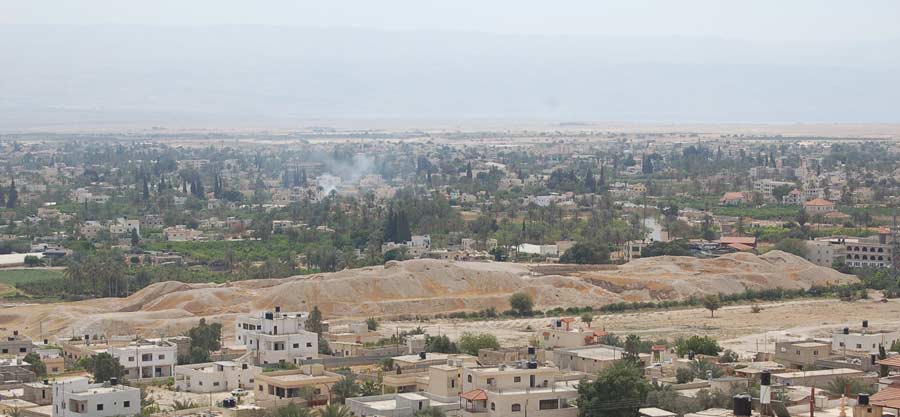
Tel Sultan - Jericho from Hilltop Restaurant, April
2008
David Q. Hall
email: dqhall59@yahoo.com
THE MIDDLE BRONZE AGE WALLS OF JERICHO
University of Rome Jericho Expeditions Web Site 1997-2000, 2009-2010 Excavation Reports
Parable of the Mustard Seed
A Mustard Field Along Highway 87-North Shore of Galilee
Mustard Seeds in the Palm of a Hand
Mustard Flowers
Giant Mustard
Upper Most Seats of the Synagogue
The Fig Tree
Mt of Olives Fig Tree, April 12-13, 2005
Fig and Pomegranite Trees Below Siloam in Jerusalem
Sycomore Fig Tree
The Good Shepherd
The Parable of the Sheep and the Goats
Goat Herder
Camels
Ritual Cleansing
Shechem
The Olive Harvest of Samaria
Mt. Ebal
Olive Tree
Pearl of Great Price
A First Century Synagogue at Gamala
Overview of Gamala
Modern Galilee Fishing Boats
Kursi
Caves and/or Tombs
Steep Slope Near Kursi
Hippos
Feeding the 5,000
On the Mountain
Walking on Water
Ramot-Tzelon area
Mt. Hermon
The Pools of Bethesda in Jerusalem
Healing Pools
Crusader Chapel and St. Ann Church
Pool of Siloam in Jerusalem
Hezekiah's Tunnel
Overlook to Siloam
Tower of Siloam
A Watch Tower in a Vineyard/Olive Grove
Grape Vines at Beth Horan
Towers
Mt. Precipice
South Face
Summit
Over the edge
Measuring Line
View of Nazareth from near Megiddo
Nazareth
The Basilica of the Annunciation
Capernaum
Healing a Paralytic in Capernaum
Bethsaida
Waterskins and Wineskins
The Fish and the Coin
Barbel
A Denarius
Casting Out a Demon
The Road to Jericho
Old Roman Road
Wilderness Above Jericho
Old Jericho
Western Wall
Gethsemane and the Cave of Gethsemane
Church of the Holy Sepulcher
Rolling Stone Tombs - Jerusalem
Other Rolling Stone Tombs
Tiberias
Solar Power in Israel
Salt of the earth
Chorazin
OTHER WEB SITES BY DAVID HALL:
Israel Photos VI
Israel Photos V -- Spring 2011
Israel Photos IV -- Pilgrimage
DQHALL.COM